Understanding Click-Through Rate: The Metric Between Ranking and Traffic
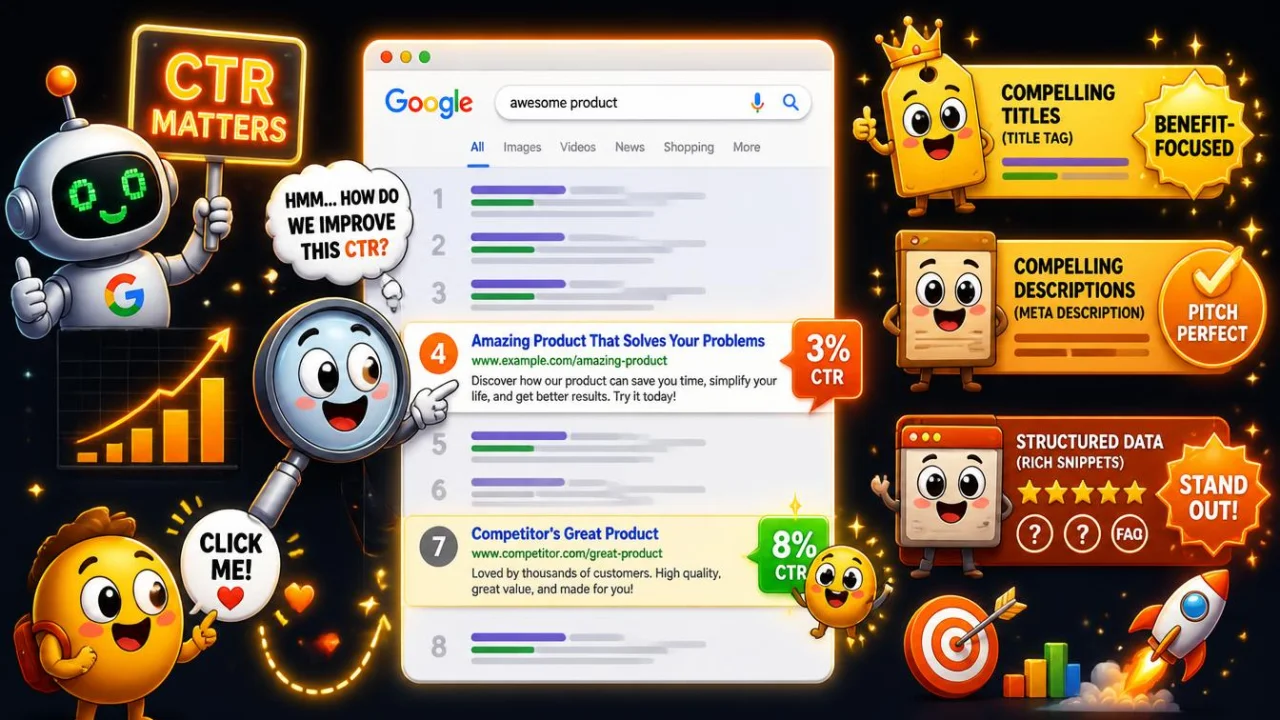
Here's a scenario that confuses many website owners: your page ranks in position 4 for a valuable keyword, but the traffic barely trickles in. Meanwhile, a competitor sitting in position 7 for the same term seems to be attracting significantly more visitors.
The explanation is almost always click-through rate one of the most important, most overlooked metrics in your entire SEO toolkit.
What Click-Through Rate Measures
Your CTR is simply the percentage of people who see your result in search and actually click it. If your page appears 1,000 times in search results and gets clicked 30 times, your CTR for that page is 3%.
CTR isn't just a vanity metric it directly influences how much actual traffic your rankings translate into, and it also feeds back into Google's evaluation of whether your result deserves its current position.
What's a Normal CTR by Position?
Click-through rates vary significantly by ranking position, and by whether special SERP features (featured snippets, ads, "people also ask") are present. As general industry benchmarks:
| Position | Typical CTR Range |
|---|---|
| Position 1 | 25–35% |
| Position 2 | 12–18% |
| Position 3 | 8–12% |
| Position 4–5 | 4–8% |
| Position 6–10 | 1–4% |
| Page 2+ | Under 1% |
These are broad averages actual CTR varies considerably by industry, query type, and SERP layout. The real value of these benchmarks is comparative: use them to identify whether your specific pages are under-performing or over-performing relative to their position.
How to Find Your Actual CTR Data
Google Search Console provides exact CTR data for every page and query combination your site appears for. Navigate to Performance → Search Results, and you'll see impressions, clicks, and CTR for each page.
Sort by impressions to find your highest-visibility pages, then check their CTR against the position benchmarks above. Any page significantly underperforming its position's typical CTR range represents a genuine opportunity.
Why CTR Underperforms (And How to Fix It)
Weak or generic title tags Your title tag is the first thing searchers see. A vague or unremarkable title gets skipped in favour of more compelling nearby results, even at a better ranking position.
Fix: Rewrite titles to be specific, benefit-focused, and genuinely distinct from competing results. Include numbers, specific outcomes, or unique angles where genuine.
Unappealing meta descriptions As covered in a related guide, your meta description is your pitch to the searcher. A poorly written or missing description significantly reduces click appeal even at strong ranking positions.
Mismatched search intent If your title and description don't clearly match what the searcher is looking for, they'll skip past your result even if it's technically well-ranked. Revisit whether your content and its presentation genuinely align with the query's underlying intent.
Missing rich snippet opportunities Structured data markup can enable rich snippets star ratings, FAQ dropdowns, recipe details that make your result visually stand out in search results, often significantly boosting CTR at the same position.
Aggressive competition with strong branding Sometimes, well-known competing brands simply attract clicks through recognition alone. In these cases, focusing on genuinely differentiated angles or more specific long-tail queries where brand recognition matters less can be more effective than competing head-on.
The CTR-Ranking Feedback Loop
Improving your CTR doesn't just increase traffic at your current ranking position it can also improve the ranking position itself. When Google observes your result consistently outperforming the typical CTR for its position, it interprets this as a signal that searchers find your result particularly relevant, which can support upward ranking movement over time.
This creates a genuinely valuable feedback loop: improve your title and description → CTR improves → engagement signals strengthen → ranking potentially improves → even more visibility and clicks.
A Simple CTR Improvement Exercise
This week, open Search Console and sort your pages by impressions. Identify your top 10 highest-impression pages. For each one, compare the actual CTR against the position benchmark table above. For any page underperforming its expected range, rewrite the title tag and meta description using the principles covered here.
This single exercise, done thoroughly, often produces meaningful traffic increases without requiring any new content, backlinks, or technical changes purely from better communicating the value of content you've already created.