What is Domain Authority and Does It Actually Matter in 2026?
If you've spent any time researching SEO, you've come across "Domain Authority" a score out of 100 that supposedly predicts how well your website will rank. Tools display it prominently. SEO forums debate it constantly. But what is it actually measuring, and does it deserve the attention it gets?
Here's an honest, clear-eyed answer.
What Domain Authority Actually Is
Domain Authority (DA) is a third-party metric created by Moz, a popular SEO software company. It's not a Google metric Google has never confirmed using anything called "Domain Authority" in its ranking algorithm.
DA is calculated using a machine learning model that looks at dozens of factors, primarily related to your backlink profile how many websites link to you, and how authoritative those linking sites are themselves.
The score ranges from 1 to 100, and it's designed to be comparative — useful for judging one website against another, not as an absolute measure of quality.
Why People Confuse It With a Google Ranking Factor
Because DA correlates loosely with search rankings sites with higher DA scores often do rank well many people mistakenly treat it as a direct Google ranking signal. It isn't. Correlation isn't causation.
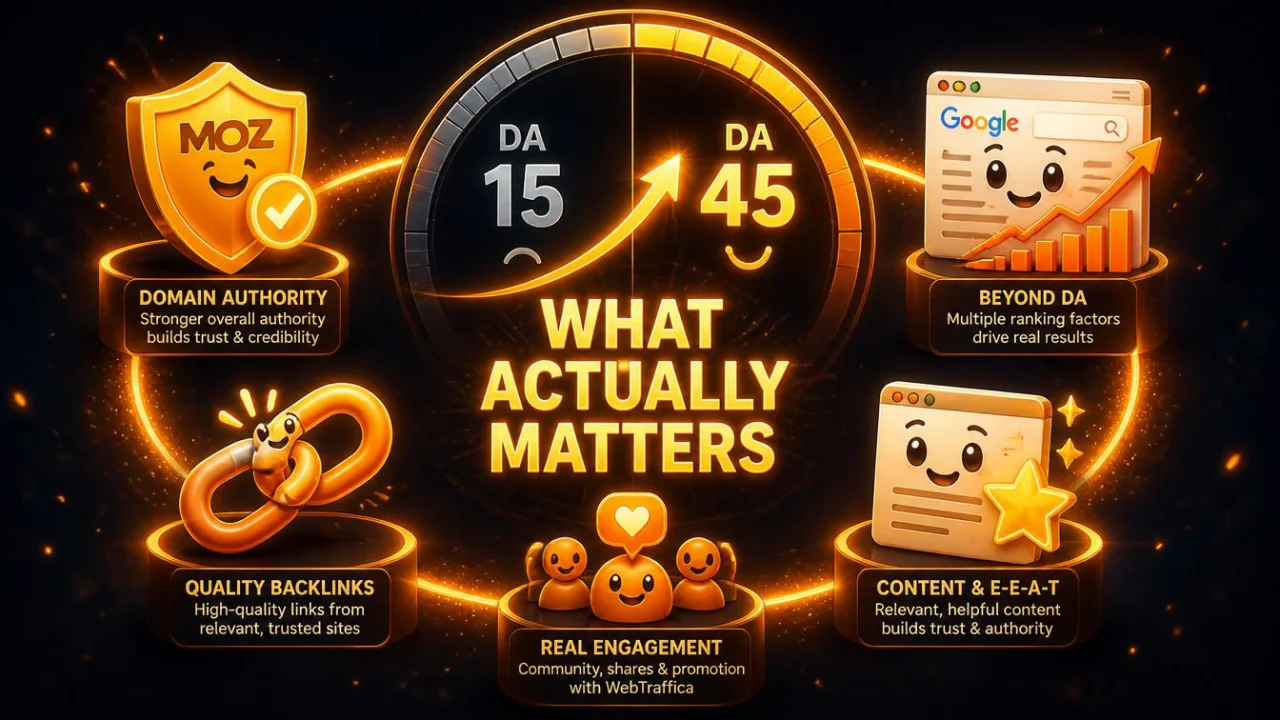
A site can have a DA of 15 and outrank a site with a DA of 45 for a specific keyword, because Google's actual ranking algorithm considers hundreds of factors: content relevance, user engagement, page speed, content freshness, and many more signals DA doesn't measure directly.
So Should You Ignore It Completely?
Not entirely. DA still has legitimate uses:
Competitive benchmarking Comparing your DA against direct competitors gives you a rough sense of relative backlink strength.
Backlink quality assessment When evaluating potential backlink opportunities (guest posts, directory listings, partnerships), checking the DA of the linking site gives you a quick quality filter. Linking from a DA 60 site is generally more valuable than a DA 5 site.
Tracking your own progress Watching your own DA trend upward over months confirms your backlink building efforts are working, even if DA itself isn't the end goal.
What Actually Matters More Than DA in 2026
Content relevance and depth. Google's algorithms have become extremely sophisticated at understanding whether content genuinely answers a search query. A highly relevant page from a lower-authority site regularly outranks a loosely relevant page from a high-authority site.
User engagement signals. How long people stay on your page, whether they explore further, whether they return these behavioral signals increasingly influence rankings more than raw authority metrics.
Page-level factors, not just domain-level. Google evaluates individual pages, not just entire domains. A single excellent page on an otherwise average website can rank extremely well.
E-E-A-T (Experience, Expertise, Authoritativeness, Trustworthiness). Google's quality guidelines increasingly emphasise genuine expertise and trustworthiness signals author credentials, citations, accuracy — over pure link-based authority.
How to Build Genuine Authority (Beyond Chasing a Score)
Rather than obsessing over the DA number itself, focus on the activities that build real authority:
Earn backlinks through genuinely valuable content. Original research, comprehensive guides, and useful tools naturally attract links from other websites without active outreach.
Build topical authority. Publish comprehensively on a specific topic area rather than broadly across unrelated subjects. Google increasingly rewards sites that demonstrate deep expertise in a focused niche.
Improve engagement metrics. New content benefits from genuine early engagement. Communities like WebTraffica connect your content with real visitors who read and interact meaningfully helping establish the kind of engagement data that supports content evaluation from day one.
Be patient. Domain authority real or measured builds over months and years, not days. Consistent quality content and genuine engagement compound steadily.
The Bottom Line
Domain Authority is a useful directional indicator, not a target to chase directly. Use it as one data point among many when evaluating your website's competitive position but focus your actual effort on content quality, user engagement, and genuine topical expertise. Those are what search engines are actually measuring, even if imperfectly reflected in any third-party score.